SPIRITUAL
INTEGRATIVE PRACTICE™
Integrative Therapeutic Modality and Professional Training
Spiritual Integrative Practice™ (SIP™) is an original integrative therapeutic modality that brings together depth psychology, somatic awareness, systemic and transgenerational perspectives, symbolic work, and a transpersonal understanding of the human experience.
Through structured professional training, you will gain an understanding of the methodology, develop practical competencies, and learn to approach the different dimensions of human experience as an interconnected whole.
A methodology accredited by the International Institute for Complementary Therapists (IICT).

NEW COHORT – NOVEMBER 2027
Enrollment for the new Spiritual Integrative Practice™ training cohort is now open. Explore the program structure, training levels, and admission requirements. Applications are now open.
What Is Spiritual Integrative Practice™?
Human experience cannot be understood solely through thoughts, emotions, or behaviour. What we experience in the present is often connected to much deeper processes: unconscious material, early experiences, bodily responses, family relationships, recurring life patterns, and meanings that have not yet become part of conscious understanding. Spiritual Integrative Practice™ was developed from the need for this broader understanding of the human experience. SIP™ is an integrative therapeutic modality with its own methodological framework. Its distinctiveness does not lie in simply combining different therapeutic techniques, but in the way different dimensions of human experience are understood, interconnected, and incorporated into a unified process of therapeutic work. The methodology encompasses psychological and emotional dimensions, the body and somatic experience, relationships and family systems, unconscious and symbolic processes, the energetic dimension, and a transpersonal perspective. These areas are not viewed as separate parts of the individual. They are understood as interconnected dimensions of a unified human experience. For this reason, SIP™ does not follow a predetermined sequence of techniques applied in the same way to every individual. Instead, it is based on understanding the process, recognising its different layers, and selecting an appropriate approach in accordance with the individual, their experiences, and their capacities. SIP™ provides a comprehensive methodological framework for understanding and engaging in integrative work with the human experience.
The Philosophy of the SIP™ Methodology
At the heart of the SIP™ approach is an understanding of the human being as an interconnected system of body, mind, energy, and soul.
Personal history is not expressed solely through memories and stories we are able to tell. It may also be present in emotional responses, bodily sensations, recurring relationship patterns, dreams, inner imagery, symbols, and unconscious patterns. For this reason, therapeutic work is not focused exclusively on what a person says, but also on how they experience and relate to their own experience.
The body is understood as an essential dimension of psychological life. Symbols and dreams can open pathways for exploring the unconscious. Family and transgenerational patterns provide a broader context for individual experience. The transpersonal perspective allows for the exploration of dimensions of experience that extend beyond conventional rational explanations.
The aim of integrative work is not to reject or suppress certain aspects of the personality, but to recognise, understand, and bring them together within a broader picture of one’s own experience.
The Core Principles of the SIP™ Methodology
- Integration: Bringing together the psychological, emotional, somatic, energetic, and transpersonal dimensions.
- Depth of Understanding: Exploring unconscious processes, inner conflicts, and recurring patterns.
- Somatic Awareness: Incorporating bodily experience into the understanding of emotional and psychological processes.
- Symbolic Work: Exploring dreams, imagination, symbols, and archetypal material.
- Systemic Perspective: Understanding the individual within the context of family, partnership, and transgenerational relationships.
- Conscious Presence: The ability to follow the process without premature interpretation or imposing solutions.
- Ethical Responsibility: Respecting professional boundaries, scope of competence, and standards of practice.
Who Is the SIP™ Training Program Designed For?
The SIP™ training program is designed for individuals who wish to gain structured education in integrative therapeutic work, deepen their understanding of the human psyche, and develop the ability to connect different dimensions of human experience.
The program is designed for:
- Psychologists, psychological counsellors, and psychotherapists who wish to expand their existing knowledge and incorporate an integrative methodological framework into their practice;
- Coaches, educators, and facilitators;
- Practitioners of somatic, energetic, and holistic approaches, as well as professionals working in personal development and human services;
- Individuals seeking comprehensive education in depth-oriented and integrative work, even if they have no previous therapeutic experience.
Admission to Level 1 does not require a previous academic background in psychology or psychotherapy. This level may be undertaken as a standalone educational program for personal and professional development.
Progression to Level 2 and eligibility for professional practitioner status are subject to specific admission requirements and program completion criteria.
What Will You Develop Through the SIP™ Training Program?
PSYCHOLOGICAL UNDERSTANDING
You will develop the ability to:
- Recognise unconscious processes and psychodynamic patterns;
- Understand the relationship between early experiences, emotional responses, and present-day life patterns;
- Explore individual experience through family and transgenerational dynamics;
- Recognise the needs, capacities, and boundaries of the person you are working with.
SOMATIC AWARENESS AND INTEGRATION
You will develop the ability to:
- Incorporate bodily sensations and emotional responses into the understanding of therapeutic processes;
- Connect psychological, somatic, systemic, and energetic perspectives;
- Structure an integrative process according to the specific case;
- Develop professional presence, reflexivity, and the capacity for self-observation.
SYMBOLIC AND TRANSPERSONAL WORK
You will develop the ability to:
- Explore the symbolic language of dreams, imagination, and archetypal material;
- Incorporate a transpersonal perspective into the understanding of human experience;
- Connect different dimensions of experience into a broader, integrative picture.
The aim of the SIP™ training program is to provide you with the theoretical understanding, practical skills, and professional confidence needed to recognise the complexity of human experience and facilitate an integrative therapeutic process.
SIP™ TRAINING PROGRAM STRUCTURE
LEVEL 1
Foundations of Integrative Depth Work
Foundational Educational Level
200 Hours | 12 Months
An introduction to the theoretical foundations and methodological principles of the SIP™ approach. Development of a fundamental understanding of psychodynamic, somatic, systemic, and symbolic processes.
Student Assignments:
- 3–5 Reflective Case Studies
- 500–800 words per case study
The focus is on theoretical understanding, personal reflection, and connecting acquired knowledge with practical examples.
Upon completion: Certificate – Foundations of Integrative Depth Work.
LEVEL 2
Certified Spiritual Integrative Practitioner®
Professional Level
400 Hours | 12 Months of Training
Advanced theoretical study, practical application of the methodology, case study work, and supervision. Professional practitioner status is awarded upon fulfilment of all educational, practical, and supervision requirements.
Student Assignments:
- 18 case studies throughout the program
- A minimum of 14 approved case studies required for certification
- Individual supervision linked to submitted case studies
Upon successful completion of all requirements: Certified Spiritual Integrative Practitioner®.
LEVEL 3
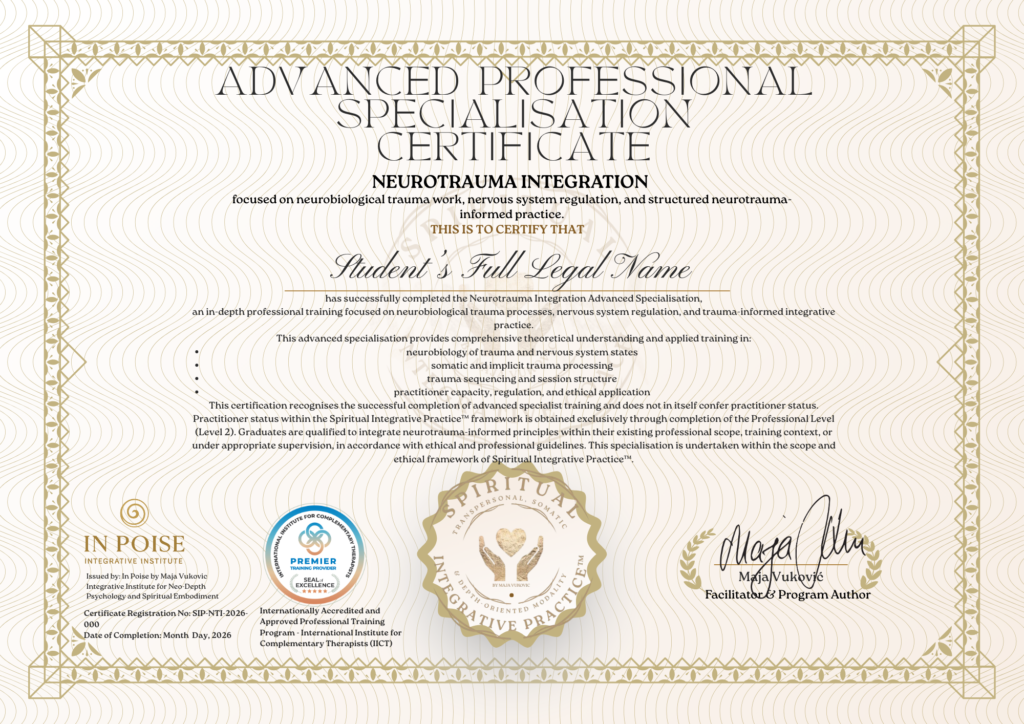
Neurotrauma Integration
Advanced Professional Specialisation
210 Hours | 12 Months
An advanced specialisation designed for practitioners who wish to deepen their understanding of the neurobiology of trauma, nervous system states, somatic integration, process sequencing, and the principles of safe practice when working with traumatic experiences.
This advanced specialisation has specific admission requirements and is not a mandatory continuation of Level 2.
The program includes group supervision, analysis of practical case studies, reflective assignments, and written integration papers. The final assessment evaluates the understanding of neurotrauma-informed principles and their responsible application within the scope of professional competence.
WHAT WILL YOU STUDY?
Six Modules of the SIP™ Methodology
The SIP™ training program is structured around six interconnected modules covering theoretical foundations, the understanding of human experience, and the practical application of the integrative approach.
Each module explores a specific dimension of the methodology, while their integration enables a more comprehensive understanding of psychological, somatic, family-related, symbolic, and professional processes.Kurikulum SIP™ training program is organised into six interconnected modules, structured according to the educational and professional requirements of the program.
Level 1 covers the first three modules, focusing on the foundations of depth psychology, family and relational dynamics, somatic awareness, and the fundamentals of integrative work.
Level 2 covers all six modules. The first three modules are explored in greater depth through advanced theoretical and practical work, while Modules Four, Five, and Six expand the training to include the symbolic, energetic, transpersonal, and professional dimensions of the SIP™ methodology.
Level 1 + Level 2
This module establishes the theoretical, psychological, and ethical foundations of the SIP™ methodology. Students are introduced to the development of depth psychology and different conceptualisations of the unconscious, as well as the ways in which unconscious processes, inner conflicts, and psychodynamic patterns shape human experience.
Areas of Study:
- History and foundations of depth psychology.
- Freud’s model of the unconscious and the structure of the psyche.
- Jung’s collective unconscious and archetypal structures.
- Psychodynamic mechanisms, defences, repression, and resistance.
- The Shadow, Anima and Animus, the Self, and other key archetypes.
- Complexes, dreams, symbols, and imagination.
- Personality development and Erikson’s stages of psychosocial development.
- Attachment theory and object relations theory.
- Trauma and personality development.
- Fundamentals of psychiatry, risk recognition, and the boundaries of professional practice.
- Professional presence, intuition, ethics, and the practitioner’s inner development.
Level 1 + Level 2
This module explores the relationship between an individual’s inner emotional world, early experiences, the family system, and recurring patterns in close relationships. Particular attention is given to understanding how family history and intergenerational influences may shape identity, emotional responses, and intimate relationships.
Areas of Study:
- Approaches to working with emotions and unconscious material.
- The Inner Child, Inner Critic, and Inner Protector.
- Foundations of systemic and family approaches.
- Methodological principles of family systems work.
- First contact and the initial session.
- Genograms and Bowen Family Systems Theory.
- Family history and intergenerational patterns.
- Couple dynamics and intimate relationships.
- Narrative approaches in systemic work.
- Loss and exclusion within the family system.
- Psychosomatic family dynamics.
- Communication and relationship mapping.
- Drawing, symbols, and symbolic work in the family context.
Level 1 + Level 2
This module introduces students to the symbolic language of the psyche and the possibilities of working with inner imagery, dreams, imagination, and archetypal material. Particular attention is given to Guided Affective Imagery and the methods of Symbol Drama (Symboldrama), including specific motifs developed and applied within the SIP™ methodology.
Areas of Study:
- Foundations of symbolic work and the meaning of symbols.
- Techniques of imagination and symbolic expression.
- Working with drawings, associations, and inner imagery.
- Archetypal processes: the Hero, the Shadow, the Anima, and the Animus.
- Application of symbolic material in individual and group work.
- Symbolic dramatisation and group processes.
- Autogenic Training and the approach of Hanscarl Leuner.
- Foundations of Symbol Drama (Symboldrama) and Guided Affective Imagery.
- Specific motifs: the flower, meadow, stream, mountain, water spring, forest edge, rose garden, and tree.
- Symbolic work with parental figures.
- Principles of facilitating and structuring the symbolic process.
- Understanding resistance and object relations in symbolic work.
- Symbolic motifs related to sexuality and identity.
Level 2
This module expands the methodological framework to include energetic concepts, ancient symbolic systems, and experiential practices that connect the body, movement, sound, imagination, and consciousness. Students explore different traditions and ways of responsibly incorporating them into the integrative process.
Areas of Study:
- Sacred geometry and energetic structures.
- Ancient symbols and universal archetypal forms.
- The energetic body, chakras, and concepts of life energy.
- Sound, light, and movement in experiential work.
- Natural elements: earth, water, fire, and air.
- Shamanic integrative processes.
- Trance, journeying, and archetypal landscapes.
- Ritual, meditation, and visualisation.
- Symbolic worldviews and methods of working with imagery.
- Integrative energetic awareness and somatic presence.
- Shamanic symbolism and dream work.
Level 2
This module brings together the previously explored theoretical and experiential areas into a coherent integrative process. Particular emphasis is placed on the relationship between body, mind, and energy, understanding somatic manifestations, nervous system regulation, and developing practical competencies for structuring the process.
Areas of Study:
- The interconnection of mind, body, and energy.
- Somatic integration and regulation.
- Theoretical approaches to the origins and development of somatic and energetic manifestations, psychiatry, and psychosomatics.
- Body image and the perception of one’s own health.
- Somatic awareness and an integrative understanding of experience.
- The nervous system and regulation strategies.
- Conscious presence and somatic processes.
- Movement, breathing, and stillness.
- Daily practice of embodied presence and energetic awareness.
Level 2
The final module focuses on the professional development of the practitioner, the integration of acquired knowledge, and the development of reflective and responsible practice. Supervision is presented as an ongoing professional process that supports the quality of practice, ethical responsibility, and recognition of one’s own limitations.
Areas of Study:
- Definition, purpose, and function of supervision.
- Roles and responsibilities of the supervisor and practitioner.
- Reflection on professional practice and case analysis.
- Recognising personal reactions, projections, and professional challenges.
- Ethics, professional boundaries, and responsibility.
- Integration of psychological, somatic, symbolic, energetic, and transpersonal perspectives.
- Development of professional identity.
- Competency assessment and ongoing professional development.
The six modules represent interconnected areas of the SIP™ methodology. Their content is not limited to foundational theoretical knowledge. Throughout Level 2, each area is explored through advanced theoretical and practical study, while previously acquired knowledge is integrated into a more comprehensive methodological framework.
Students deepen their understanding of psychodynamic processes, personality structure, unconscious dynamics, and the foundations of systems theory, while also exploring the relationship between emotional processes, the nervous system, and psychosomatic manifestations.
A particular part of the training is dedicated to symbolic and imaginative work. Through guided affective imagery processes, students explore methods of investigating unconscious material, symbolic representations, and inner conflicts, as well as their relationship to psychodynamic and relational processes.
These areas are not studied as disconnected techniques or separate approaches. Their interconnection forms the foundation of the SIP™ methodology: psychological understanding is complemented by somatic awareness, symbolic exploration, and a transpersonal perspective.
At the professional level, the focus shifts from understanding individual theoretical areas to integrating them into a structured therapeutic process, supported by case studies, practical application, individual supervision, and the development of professional competencies.
What Does the SIP™ Training Program Look Like?
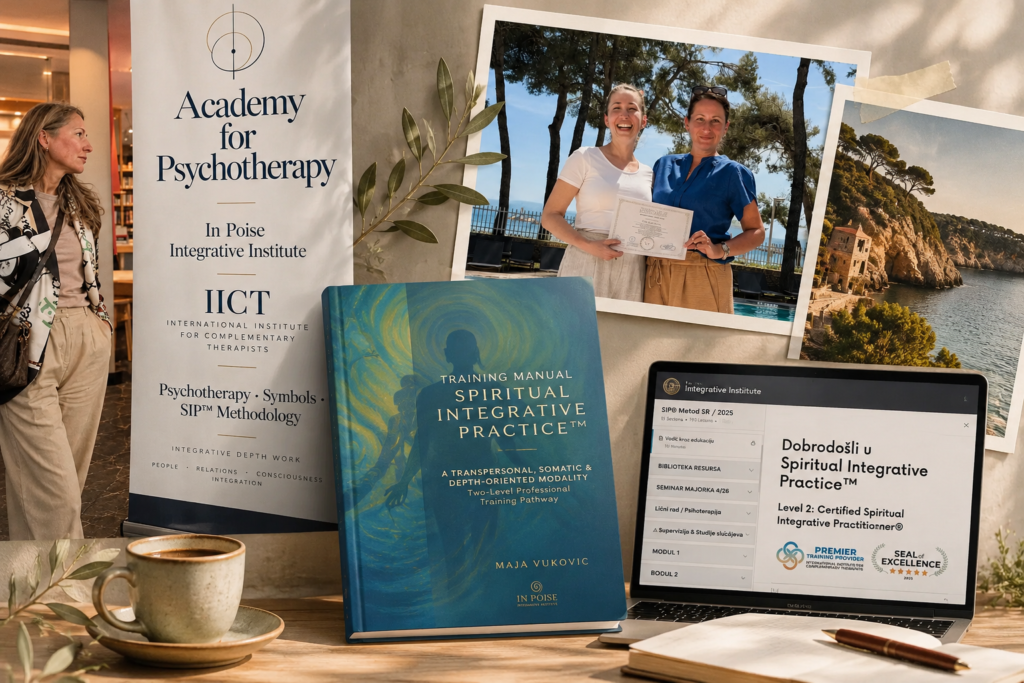
SIP™ edukacija osmišljena je kao strukturisan obrazovni proces koji povezuje teorijsko znanje, samostalno proučavanje, iskustveni rad i praktičnu primenu metodologije.
Tokom programa polaznici postepeno razvijaju razumevanje različitih oblasti SIP™ pristupa, rade sa konkretnim studijama slučaja i povezuju teorijske koncepte sa praktičnim iskustvom.
Edukacija se odvija putem online platforme HUB, uz autorske nastavne materijale, redovne Masterclass susrete i supervizijsku podršku u skladu sa nivoom programa.
What Does the Training Program Include?
An original training manual of approximately 500 pages, covering theoretical foundations, training modules, methodological principles, practical guidelines, and professional standards.
Structured lectures and supplementary educational resources designed to support learning, revision, and in-depth exploration of the course material.
Online sessions dedicated to exploring key topics in greater depth, integrating theoretical knowledge, and exchanging experiences.
Practical assignments and case study analysis through which theoretical knowledge is connected to real-life examples of human experience.
Level 1 includes group supervision sessions and feedback. Level 2 includes individual supervision following the approval of submitted case studies.
HUB – Online Student Platform

About the Creator of the SIP™ Methodology
Maja Vuković
Founder of In Poise Integrative Institute and Creator of Spiritual Integrative Practice™
Maja Vuković developed the SIP™ methodology through years of education, research, and professional practice in the fields of psychology, psychodynamic psychotherapy, depth-oriented work, somatic and transpersonal approaches, symbolic processes, and integrative methods. Throughout her professional development, she explored the different ways in which human experience manifests through the psyche, emotions, the body, relationships, unconscious processes, and deeper layers of personal experience. Over time, the need emerged to bring this knowledge together within a unified methodological framework — one that would go beyond familiarity with different approaches and enable their meaningful integration into work with people. This process led to the development of Spiritual Integrative Practice™. SIP™ is her original integrative therapeutic modality, shaped by bringing together different theoretical and practical perspectives into a coherent methodological approach to understanding and facilitating inner processes. Today, she leads the training and professional development of practitioners within this methodology. She is the author of several books and manuals, including Unlock Your Story, available in Serbian and English, which forms part of the educational resources of the SIP™ program.
Mallorca Residential Seminar
Four-Day Experiential Seminar | 44 Hours
Experiential work represents an important dimension of the SIP™ training program. In addition to theoretical learning and practical assignments, Level 2 students have the opportunity to participate in an intensive four-day seminar in Mallorca.
Throughout the seminar, the methodology is explored through direct experience, group processes, somatic awareness, symbolic and imaginative work, meditation, movement, breathwork, and the integration of previously acquired knowledge.
The seminar comprises a total of 44 hours. Participation is optional: students may choose between the online training program and the package that includes the seminar in Mallorca.
The seminar is also open to participants who are not enrolled in the SIP™ training program but wish to experience this form of integrative work. For the program, details, and registration, visit the event page.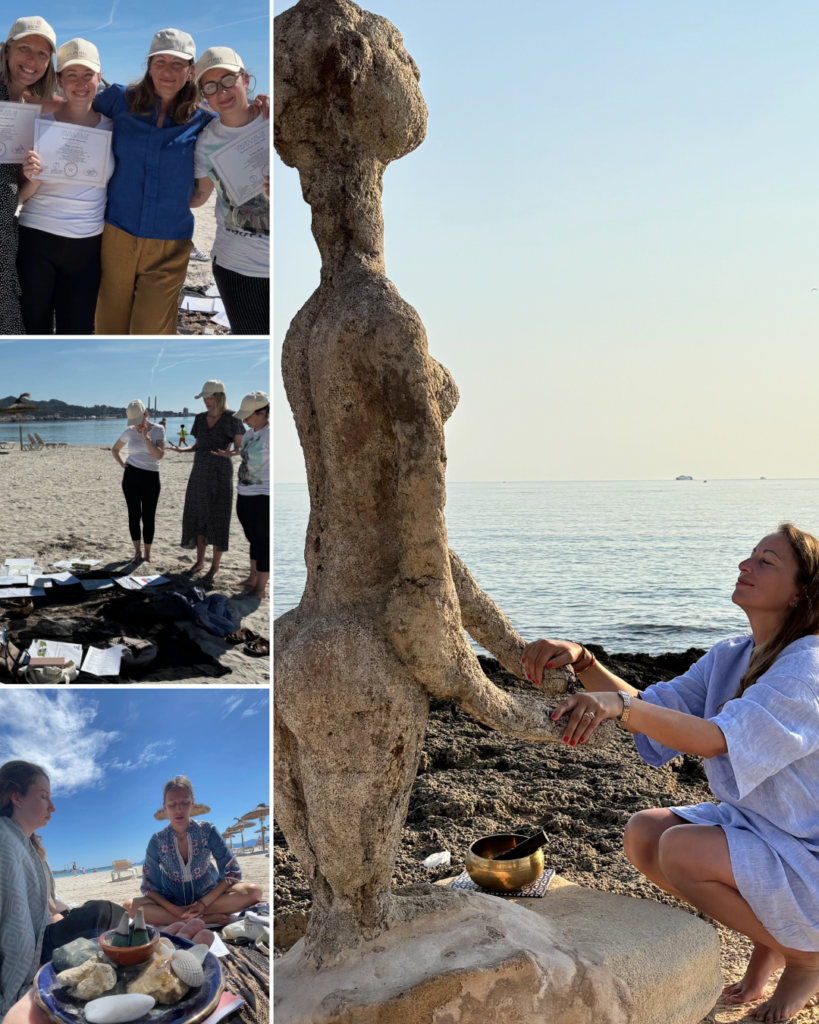
INTERNATIONAL ACCREDITATION AND PROFESSIONAL FRAMEWORK
Spiritual Integrative Practice™ is a methodology accredited by the International Institute for Complementary Therapists (IICT). This accreditation represents international professional recognition of the methodology within the framework of this organisation.
Upon completion of Level 2 and fulfilment of all prescribed educational, practical, and supervision requirements, students are awarded the certificate:
Certified Spiritual Integrative Practitioner®
Following this, graduates may apply for individual professional membership with IICT and appropriate professional insurance, subject to the organisation’s criteria, practitioner category, insurance policy conditions, and application approval.
IICT accreditation applies to the SIP™ methodology. Certificates of completion for the educational levels are issued by In Poise Integrative Institute.
The SIP™ certificate confirms education and competencies within this methodology. It does not constitute a state-recognised psychotherapy qualification or replace prior professional qualifications or licences in regulated professions.
What Happens After Completing Level 2?
Nakon završetka profesionalnog nivoa i ispunjavanja svih propisanih uslova, practitioners may develop their practice within the SIP™ methodology.
The competencies acquired may be applied to:
- Facilitating individual integrative processes;
- Facilitating group processes;
- Integrating the SIP™ methodology into existing professional practice;
- Developing an independent online practice;
- Pursuing further professional development and specialisation.
Investment in the Training Program
Choose the training level that best aligns with your previous education, professional experience, and goals. Each level has a clearly defined structure, duration, and scope of training. Instalment payment options are available for all programs, subject to arrangements with the Institute.
LEVEL 1 · FOUNDATION
Foundations of Integrative Depth Work
3.333 €
200 Training Hours | 12 Months
Foundational educational level of the SIP™ methodology.
Included in the tuition fee:
- SIP™ Training Manual
- Video lectures and learning materials
- Monthly Masterclass sessions
- Reflective case studies
- Group supervision sessions and educator feedback
- Access to the educational HUB and student community
Payment: Instalment payments available in up to 6 monthly instalments.
LEVEL 2 · PROFESSIONAL
Certified Spiritual Integrative Practitioner®
6.666 €
400 Training Hours | 12 Months
Professional level of the SIP™ training program.
Included in the tuition fee:
- Advanced educational content and learning materials
- Practical application of the methodology
- 18 case studies throughout the program
- Individual supervision linked to approved case studies
- Group educational and integration sessions
- Access to the educational HUB and professional community
Payment: Instalment payments available in up to 12 monthly instalments.
LEVEL 2 · RESIDENTIAL EXPERIENCE
Certified Spiritual Integrative Practitioner® – Mallorca
7.777 €
400 Training Hours + 44 Seminar Hours
Professional level with a four-day experiential seminar in Mallorca.
Included in the tuition fee:
- Complete Level 2 training program
- Practical work and case studies
- Individual and group supervision, as outlined in the program
- Four-day Residential Seminar in Mallorca
- 44 hours of experiential and integrative work
- Access to the educational HUB and professional community
Payment: Instalment payments available in up to 12 monthly instalments. The seminar fee of €1,555 must be paid in full immediately upon registration.
LEVEL 3 · ADVANCED SPECIALISATION
Neurotrauma Integration
Posebni uslovi upisa
210 Hours | 12 Months
Advanced professional specialisation for practitioners seeking to deepen their knowledge of the neurobiology of trauma and neurotrauma-informed integrative practice.
The program includes:
- Neurobiology of trauma
- Nervous system states
- Somatic integration
- Process structuring and sequencing
- Group supervision and case analysis
- Reflective assignments and written integration papers
Investment and Admission Requirements: Please explore the program details.
Button: Learn More About Level 3
Begin Your Training in Spiritual Integrative Practice™
The SIP™ training program is designed for those who wish to understand human experience through multiple interconnected perspectives and develop the ability to engage in integrative practice based on a clearly defined methodology.
Through structured education, an original training manual, theoretical instruction, experiential work, case studies, and supervision, you will explore the methodology developed by Maja Vuković and progressively develop the competencies required for its application.
The new SIP™ training cohort begins in November 2027.
Frequently Asked Questions About the SIP™ Training Program
SIP™ is an integrative therapeutic modality that brings together depth psychology, psychodynamic processes, somatic awareness, systemic and transgenerational perspectives, symbolic work, the energetic dimension, and a transpersonal understanding of human experience.
SIP™ is an integrative therapeutic modality with its own methodological framework. Its distinctiveness lies in bringing together different theoretical perspectives and experiential approaches into a coherent system of understanding and practice.
SIP™ was developed by Maja Vuković, a psychologist, psychotherapist, and founder of In Poise Integrative Institute.
Yes. The SIP™ methodology is recognised by the International Institute for Complementary Therapists (IICT).
No. Previous therapeutic education or professional experience is not required for admission to Level 1.
Yes. Level 1 is a standalone educational program and may be completed for personal and professional development.
Level 1 lasts 12 months and comprises 200 hours of training.
Level 2 includes 12 months of formal training, followed by an additional 12 months of support to complete the remaining educational, practical, and supervision requirements.
No. Level 3 is an advanced professional specialisation and is not a mandatory requirement for completing Level 2.
Admission to Level 2 is subject to meeting the prescribed eligibility criteria and demonstrating relevant prior education or experience. Completion of Level 1 represents the foundational educational pathway towards the professional level.
Yes. Case studies are a mandatory component of Level 1 and one of the requirements for obtaining the certificate.
Level 1 includes group supervision sessions and educator feedback as part of the educational process. Individual supervision is not included in the standard Level 1 package.
Students are provided with 18 case studies. A minimum of 14 approved case studies is required to complete the professional level.
After submitting a case study, the educator reviews it and provides feedback. Once the case study has been approved, the student schedules an individual supervision session during which the case, the application of the methodology, and professional decision-making are examined in detail.
Yes. Individual supervision following the approval of case studies is part of the Level 2 professional training process, in accordance with the prescribed requirements.
No. A minimum of 14 approved case studies out of the 18 included in the program is required.
The Foundations of Integrative Depth Work certificate, upon fulfilment of all prescribed program requirements.
The Certified Spiritual Integrative Practitioner® certificate, upon successful completion of all Level 2 educational, practical, and supervision requirements.
No. The SIP™ certificate confirms the education and competencies acquired within the methodology. It does not constitute a state-recognised psychotherapy qualification or replace formal education or licensing in regulated professions.
After completing Level 2 and fulfilling all professional certification requirements, practitioners may develop their practice within the SIP™ methodology, in accordance with their competencies, professional scope of practice, and applicable regulations.
Upon completing the professional level and fulfilling the prescribed requirements, students may apply for individual professional membership and appropriate insurance through IICT. All our practitioners are eligible for professional insurance coverage in more than 40 countries worldwide.
Yes. The training program is delivered online through an educational platform, recorded learning materials, and scheduled online sessions.
The online format allows for greater flexibility in managing your time. However, you will need to allocate time for lectures, independent study, case studies, practical assignments, and mandatory sessions.
The HUB is a private online platform for SIP™ students. It provides access to learning materials, recorded lectures, additional resources, and a space for communication and the exchange of experiences.
No. The seminar is an optional experiential component of the Level 2 program. You can choose either the online program or the package that includes the seminar.
Four days, comprising a total of 44 hours of educational and experiential work.
The first step is to complete the application form. Once you have submitted your application, you will receive information about the program, admission requirements, deadlines, and payment options.
Yes. The Institute offers monthly instalment payments according to an agreed payment plan. Level 1 can be paid in up to six monthly instalments, while Level 2 can be paid in up to twelve monthly instalments, subject to the current enrolment terms.
You can contact the Institute or schedule an informational call to receive further details about the program and admission requirements.
Level 2 comprises 12 months of formal training, followed by an additional support period, giving students up to 24 months in total to complete all educational, practical, and supervision requirements.
After the two-year period has expired, any outstanding supervision requirements may be completed through additional paid individual supervision sessions. The fee for each individual supervision session is €90 per case study.
Individual supervision sessions are not included in the standard Level 1 tuition fee. Students who wish to gain practical experience with the SIP™ methodology through individual supervised work while completing Level 1 may book additional individual supervision sessions. The fee for each session is €90.
Yes. Students may apply for IICT student membership during their training and undertake practical work under supervision. Depending on the applicable student membership category, they may also be eligible for professional insurance covering supervised student practice, subject to the terms and conditions of the IICT program.
Yes. After completing Level 2 and fulfilling the prescribed requirements, students may apply for professional membership with IICT and professional insurance covering practice within the scope of their acquired competencies. The application involves completing the relevant professional questionnaire and undergoing IICT’s assessment process. Professional insurance is available on favourable terms, subject to the applicable membership category and policy conditions.
Students may submit a written request to withdraw from the program and receive a partial refund no later than 120 days before the official program start date. If the request is approved, the non-refundable deposit of €1,000 and an administrative fee will be deducted from the amount paid.
Once the training program has officially commenced, no refunds will be issued, regardless of the reason for withdrawal, non-attendance, or partial participation in the program.
In the event of a medical emergency, students may submit a written request to defer their training or transfer to the next cohort. Each request will be considered on an individual basis. Deferral does not automatically entitle the student to a refund.
A €1,000 deposit is required to reserve a place in the program, in accordance with the program’s terms. The deposit is deducted from the total tuition fee, is non-refundable, and confirms the reservation.
Under the Mallorca package, the €1,555 seminar fee must be paid in full. This amount is included in the total package price and is not an additional cost. The seminar is an optional component of the Level 2 program.
To meet the certification requirements, students must attend at least six live Masterclass sessions and complete all mandatory educational, practical, and supervision assignments.
If a student is unable to attend a live session, they must watch the recording within seven days and submit the corresponding assignment.
Yes. Before the training program begins, students are required to complete an application questionnaire covering their previous education, professional experience, motivation, and other relevant admission information.
They must also agree to the Code of Ethics, professional standards, and program terms and conditions, and sign a confidentiality and non-disclosure agreement covering the educational content.
The supervised practical phase is an integral part of the Level 2 program. Work with clients is carried out within clearly defined competencies, with appropriate documentation, informed consent, and supervision support.
No. The program and methodology are designed for working with adults. Practical application must remain within the practitioner’s education, competencies, and professional scope of practice. Practitioners who hold a licence to work with children may apply the method within the scope of their professional authorisation.